Biography
Writing about self-directed learning to empower generations to come.
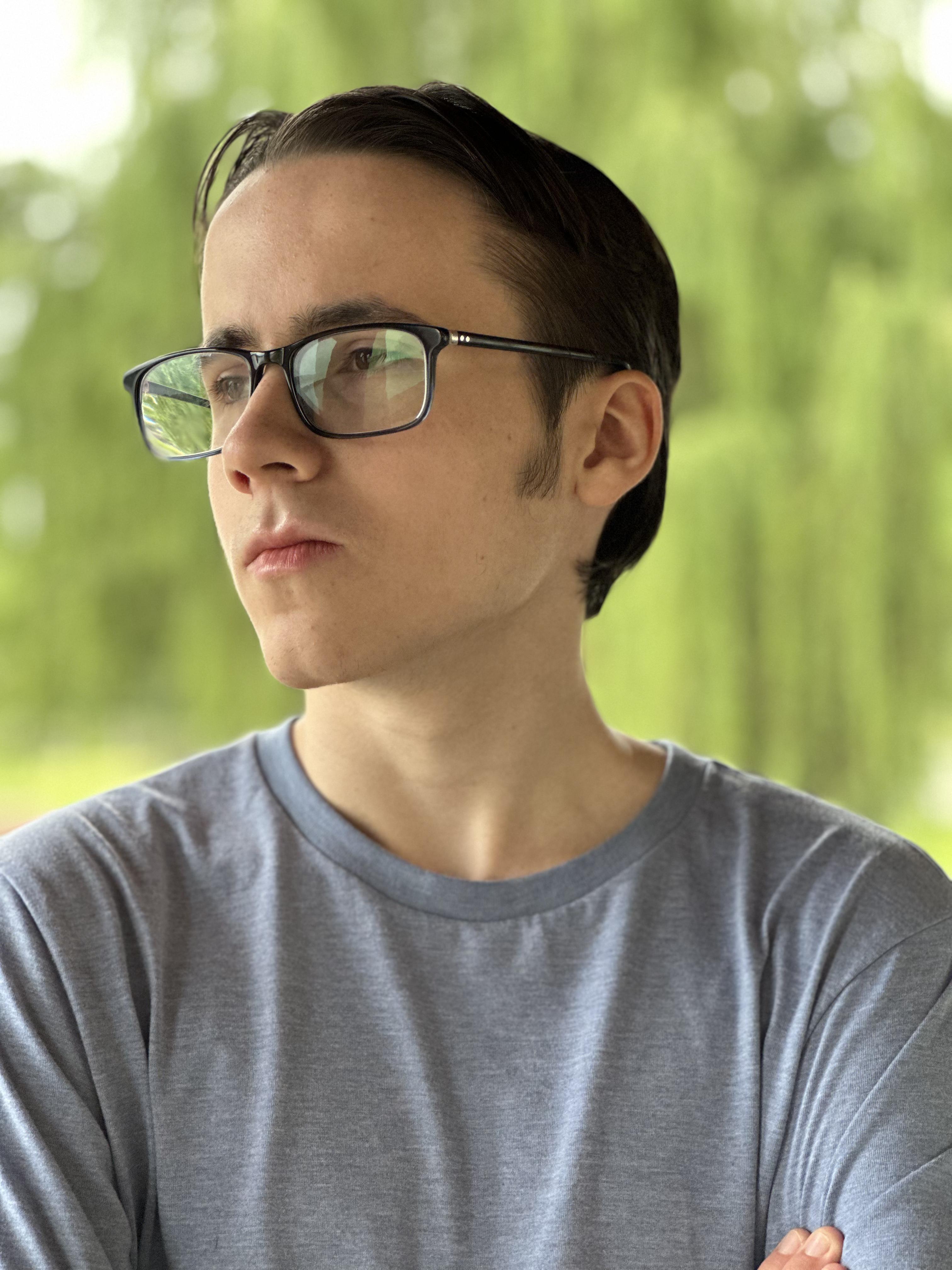
Elijah Gwyn, 15, is a lifelong learner and educational visionary committed to sharing the transformative power of self-directed learning (SDL). After witnessing a decline in student achievement in his own school, he decided to present independent learning as the vital solution with his book, The Sea of Knowledge: Navigating Academic Decline with Self-Directed Learning. Gwyn resides in Missouri with his parents and two brothers, where he continues his journey as an SDL advocate and a lifelong explorer of the sea of knowledge.
Inspired by failure in a math competition, Gwyn began his self-directed learning journey at age 11. Over the years, this approach has allowed him to progress rapidly; he now studies college-level mathematics, physics, Spanish, vocabulary, and humanities. Fueled by an enduring passion for knowledge, Gwyn’s self-directed learning has not only accelerated him into advanced courses but has also transformed his worldview. In his free time, he enjoys playing and composing on piano and violin.
During middle school, Gwyn observed a widening proficiency gap among his peers and, through research, realized this shift reflected a national decline. Recognizing the need for change, he drew on the very framework that he had developed over three years of self-directed learning. As an eighth grader, Gwyn began writing to propose an interdependent triad—students, parents, and teachers working together—to foster a culture of self-directed learning.
The book’s central metaphor began with Gwyn’s essay for the National Junior Honor Society, in which he described scholarship as “the perpetual choice to dive deep through the endless sea of knowledge.” What started as a student presentation ultimately evolved into this book, created to transform the abstract depths of human knowledge into a tangible adventure. Beyond authorship, Gwyn aspires to expand his vision by establishing an SDL non-profit dedicated to sharing self-directed learning internationally and increasing access and equity.
Gwyn imagines a world where knowledge is cherished, and every student flourishes as an explorer. He envisions future leaders more ready than ever to advance humanity’s legacy, ensuring that knowledge is preserved and passed down through generations. While one individual may be a mere blip in the vast fabric of the universe, together—driven by a shared passion for learning—we become a resilient, resourceful species. With The Sea of Knowledge, Gwyn demonstrates that this is not just a dream, but an actual possibility.
My Educational Philosophy
“Because every learning path is unique, I advocate self-directed learning as the key to equipping the next generations of innovators with a voracious passion for learning.”
Educational Growth
My Story
Somewhat ironically, my success was born from failure.
Everything—my entire self-directed learning journey, the steps that led to who I am today—started one day towards the end of fifth grade. Having been homeschooled for the last two years due to the pandemic, I was greeted once again by the friendly face of the public school system when I returned for my final year of elementary school. In that year, I was given the lucky opportunity to be one of the sixteen students to participate in my school’s Math Olympiad Program.
Though I certainly did try quite hard, I failed; my team didn’t win, and neither did I. I vividly remember the winners of the school competition lining up along the wall, the teacher taking pictures while they smiled brilliantly, holding their plaques. Then, there I was, in the corner, in the dark.
Back then, I viewed it as a major setback. Yet it was precisely this failure that was the catalyst for my self-discovery. I had always loved math, but as I looked out the window of the classroom, out onto the horizon, I realized that I had a spark, a desire to learn more, deep within me. Suddenly, I didn’t just want to wait to learn math; I wanted to learn more math now. And that’s precisely what I did—the summer before my first year of middle school, I spent nearly all my free time studying math with nothing more than a simple math workbook and my pencil. It was fascinating, the way I could be simply sitting at my desk, the warm summer breeze ruffling my hair, yet I would actually be sailing the sea of knowledge, diving into the wondrous world of ratios and graphs and probability. It was a dream. Yet this dream was real.
In three months, I mastered all middle school math.
In the beginning, I had no plan. But it turns out that I didn’t need one then. My spark had grown into a flourishing, glowing compass that guided my way across my self-directed learning journeys. However, as I continued to study, I started developing certain habits. Setting goals. Charting my course. Reviewing with exercises. They were simple, but they were what morphed into the five-step self-directed learning cycle that I use today.
But when I returned to school for sixth grade, it was an entirely different story. Where at home I had had absolute freedom of exploration, guided by my boundless curiosity, I was now experiencing the public education system from a completely different perspective. While studying algebra at home, I was “learning” sixth-grade math in the classroom. Material that I had already mastered, had already moved far beyond, was the only item on the menu. It was miserable, and nothing was done about it.
As my independent journey continued throughout sixth and seventh grade, I was forced to watch the class progress along its rigid schedule. I pretended to listen to the teacher while, in reality, I was scribbling tiny algebra problems on the corner of my whiteboard desk to give at least a bit of relief. I completed tests before the timer even started, and nearly always received full points. I’m a forward-obsessed learner, and reviewing what I already know is simply an incredibly painful process to me. I constantly wondered: why couldn’t I just attend a class at the level where I was then? Why spend my time there?
Not only was I struggling with my restrictions, but I was also noticing many gaps in my fellow students’ knowledge. They were certainly capable of it, but many of them—even in the advanced math class I was in—struggled with simple multiplication and understanding decimals. I tried to help, but the more I did, the more apparent the plummet in proficiency became. After I bit of research, I discovered that it wasn’t just my school; no, the entire nation was experiencing an enormous decline in proficiency that started around the early 2000’s and only worsened with the pandemic. Naturally, my math teachers adjusted their curriculum and focus to these lower levels, which only made my experience more lacking. It wasn’t the fault of any teacher, but simply a product of the way our public education system works, its factory-based progression.
Yet there was hope. My seventh-grade math teacher took time to meet me where I stood. After contacting the district heads, she gave me several tests. I passed them and enrolled in an accelerated math course. In the second semester of seventh grade, I began my first high-school math class: Honors Geometry.
But I didn’t stop there in my journey; I continued to study science and Spanish, allowing me to skip a year of science and take upper-high-school Spanish in eighth grade. My favorite subject, math, has seen the furthest progression—after some more time studying at home (and by some, I mean quite a lot), I began AP Calculus BC on Khan Academy at the end of seventh grade.
I’m no genius; I’m just an explorer of the sea of knowledge, led by my own compass—my own intrinsic desire to learn. I wrote The Sea of Knowledge so that more children my age can, too.
–––––––––
This is an excerpt from Chapter 1 of The Sea of Knowledge, expected to be published in Fall 2026.“I simply like to think that I’m starting my mission early.”
Looking Forward
My Vision
In two hundred years, none of us will exist. We will no longer guide the future of our species; we will no longer be able to grow and nurture the youth of tomorrow. Instead, two things will remain: future generations of Earth and the everlasting knowledge passed down for millennia. If we want humanity to thrive—not only today, or the next ten years, not even in the next hundred, but for as long as possible—then we must protect this knowledge. We must ensure that the leaders of tomorrow can prosper, expand, and bring justice to the world; that they can dive deeper into the sea of knowledge than ever before and apply what they find there.
Our future depends on it.
I see a world where knowledge is not something that one is required to absorb through long lectures or boring busywork, but rather as a fascinating journey across the sea of knowledge—an adventure to be savored. I see a world where knowledge is explored independently out of the unquenchable thirst for exploration. I see a world where humanity can continue to not only survive, but to flourish and blossom.
With the power of self-directed learning, I believe this world is possible.
“An individual can only do so much in one life; the best efforts are those that are spread across centuries, generations inspired by the same yet evolving vision. In the infinite fabric of the universe, a single person is nearly nothing; a sustained vision is everything.”
Next Steps
My Future
The book is only the first step. I plan to dedicate my life to putting the core vision behind The Sea of Knowledge into effect. This isn't a detailed plan yet, but here are some goals I hope to accomplish in my lifetime that are linked to this mission of sharing the power of self-directed learning:
- This Fall: Found a student organization at my high school dedicated to establishing a welcoming community that embraces SDL as a supplement to traditional education. This is not only an initial pilot program; it is also an opportunity to create meaningful change, starting locally and hopefully expanding to other schools. Additionally, it is around this time that I will start my SDL newsletter: a tool to not only further supply interested parents, educators, and students with the resources and knowledge necessary to self-study, but also to connect the SDL community.
- ~2028: Launch an SDL app that serves not as a course itself, but a guide that steers users through their SDL journeys. I plan for the app to be free to download; the basic version will include all the necessary features to embark on a voyage. However, I plan to eventually add additional paid features solely to gain the revenue necessary to fund the organizations detailed in the following step.
- ~2030: Establish two SDL organizations: the first a non-profit dedicated not only to spreading SDL but also to making it more equitable and achievable for all students. It will possess a for-profit subsidiary, with all its gains feeding into the non-profit mission. This will ensure that the non-profit has a consistent revenue source without unsustainably relying on donations. The app that I will create will serve as the first source of funds for the for-profit, which will continue to develop it into a full learning ecosystem, balancing access with profit that will always be given to the non-profit. I hope that these two organizations will continue to grow and impact the world long after my career is over.